

Just Chilling
What else is there to do but doomscroll on these freezing winter days? New finds from fashion's favorite embroideries to Manhattan's chic private clubs and a new wave sport...and more Paris
Pink Is The Navy Blue of The Grammys

Leave it to Pharrell to hijack almost all of the Grammys’ menswear styles and still look the coolest in his baby pink velvet suit. He arrived with Malice and Pusha T in matching suits before their epic snowy performance of “So Far Ahead.” BTW, we don’t need anymore snow on the East Coast. Seeing so much velvet on the red carpet reminds me I should dig out that fab Tom Ford for Gucci classic magenta velvet tux from 1997. Of course it won’t fit now—and it’s been copied by J. Crew and reworn by Gwyneth, so maybe not—but it’s a nice thought. Just keep working, Pharrell. KB
Fashion Threads


The first looks on the runway at the recent Chanel haute couture show in Paris featured the house’s classic chain handbag cut out of feather weight chiffon. Each bag came with a hand-embroidered letter with a personal message. This play on couture, which means sewing in French, lent an instant lightness to the entire collection and got me thinking about the idiosyncratic nature of French craftsmanship. I’ve been obsessing over the work of the French textile artist Sandrine Torredemer who uses silk thread and found textiles—old sheets, hospital gowns, burlap—to stitch tiny, poetic scenes of everyday life, often inspired by her own memories of childhood. Born in Perpignan, near the Mediterranean, Torredemer learned to embroider from her grandmother and has always loved summer, hence all of the beach scenes in her work. If you can’t get to one of her exhibits at La Galerie des Ateliers in Paris, you can check out her instagram, @la_filature. Forget book clubs; it’s time for Sip & Stitch clubs. KB


Going Private
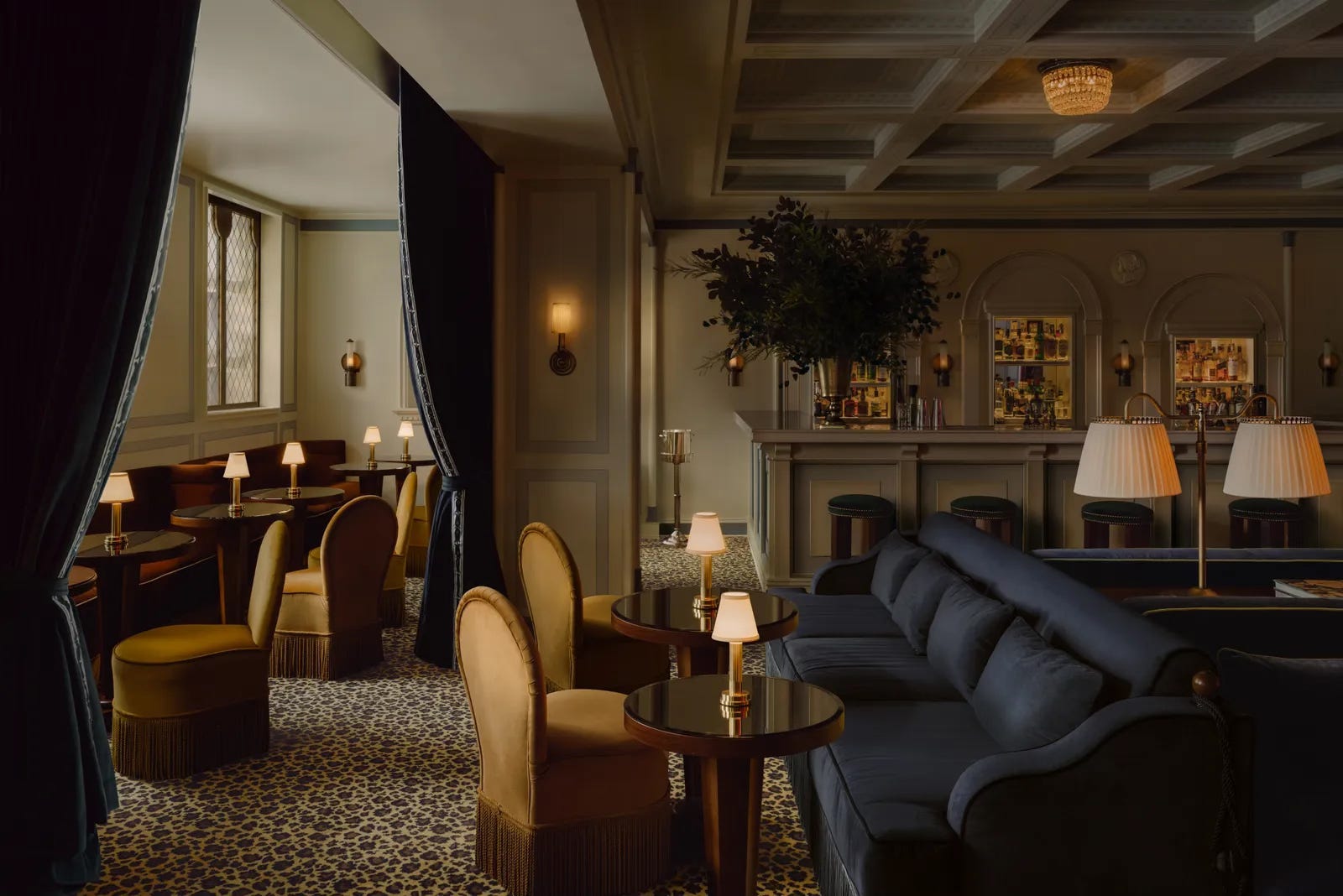
Even as Manhattan’s old-guard private clubs—the Knickerbocker, the Metropolitan Club, and the Century Association among them—continue to thrive, the city is experiencing an influx of new upstarts. The past two years has seen the arrival of San Vicente West Village, designed by London design legend Rose Uniacke; Maxime’s, crafted by Rifat Ozbek who also did 5 Hertford Street in London for the same owner; Chez Margaux, with a restaurant by Jean-George Vongerichten; and the ultraluxe Coco’s atop the former GM Building. When the owners of London’s Twenty Two decided to open a New York outpost, they wanted something different. They turned to the buzzy London firm Child Studio, which is known for residences and shops imbued with restrained luxury and a love of history. The designers Alexy Cos and Che Huang tell Editors@Large about the challenges of devising a new hotel, restaurant, and private club within a historic building off Union Square. MB


The New York version of the Twenty Two club is more understated than the London original, which you did not design. Was that deliberate?
Yes, very much so. New York is less ceremonial, more fluid, and we felt the interiors should respond to that with clarity and restraint, rather than overt statement.
Your residential work is subtle and refined. Did you feel pressure to “amp up” the design for a club and hotel?
A club and hotel must support many lives at once—private moments, chance encounters, long dinners, late nights. We focused on spaces that could adapt to those shifts through atmosphere rather than spectacle.
Your work is known for its respect for history. What did you look to when creating an American club?
We were drawn to early American domestic traditions—interiors that were modest, utilitarian, and sincere rather than overtly decorative. Rather than quoting a specific period, we focused on creating interiors that feel accumulated over time.
How much did the history of the building inform your design?
The Margaret Louisa Home was originally conceived as a place of refuge and independence for women arriving alone in New York, and that social purpose stayed with us. No original interiors survived, so archival research became essential. Our approach became an imaginative restoration: a contemporary reinterpretation of the house’s original spirit.
What are members looking for in a club today?
People are looking for a sense of belonging without pressure. Clubs today are less about exclusivity for its own sake and more about creating an environment where different worlds can intersect—creatives, locals, visitors—without friction. What has been most rewarding is how naturally the spaces were taken on—not only by members, but as part of the wider life of the city. For us, that sense of familiarity and ease, of the place feeling lived in rather than staged, is the greatest success.
Fan Fiction


One of my favorite galleries at the Metropolitan Museum is not really a gallery at all, but rather the passageway at the top of the grand stair that leads to the 19th-century paintings collection and the galleries for temporary exhibitions. Next time you’re on your way to the Met’s latest blockbuster, slow down, because you never know what the curators might have on display—17th century depictions of the streets of Paris, charming British posters exhorting citizens to grow vegetables during World War II, an intimate grouping of Baroque red chalk drawings. Through May 12, the space is devoted to a once-crucial fashion accessory. “Fanmania” ranges around the globe, but its focus is on the avant-garde artists of the 19th century who became fascinated with this expressive, hand-held object that didn’t just keep you cool but could also signify your status, reflect your taste, and even serve as a tool of seduction. MB
